October 1, 2026
Hurghada eSIM guide: getting online from HRG airport to El Gouna and the reefs
Which Egyptian networks reach Hurghada, what HRG airport offers on arrival, and which eSIM plan fits a Red Sea week, with prices checked on 1 October 2026.
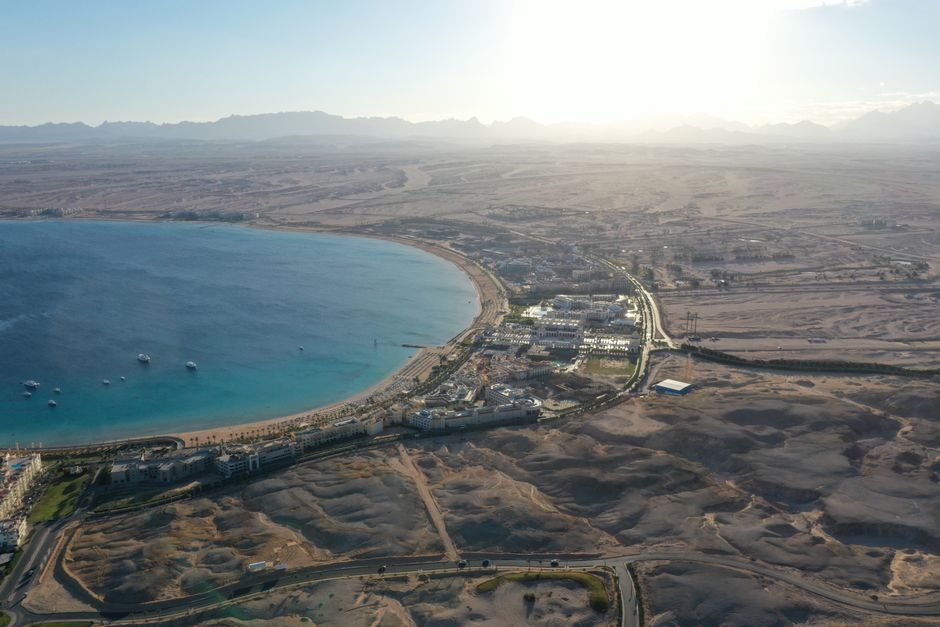
Photo: Mo Ismail — Pexels
Part of our Egypt eSIM guide: all articles and key facts →
An eSIM for Hurghada puts your phone online as soon as the plane lands at HRG, without queuing at a kiosk with your passport. The resort coast stretches for tens of kilometres, from El Gouna in the north to Makadi Bay and Soma Bay in the south, so mobile data matters for transfers, taxis, boat bookings and messages. This guide sets out what is measured, what is not, and which plan fits a Red Sea holiday.
Key takeaways
- We found no published mobile speed test for Hurghada itself: Opensignal, Ookla and nPerf report Egypt as a whole, and the regulator NTRA publishes no speeds by region: its latest regional report only grades areas pass or fail, and its national drive-test averages were reported only by the press, so any "Mbps in Hurghada" figure from a seller has no method behind it.
- Hurghada airport handled 11,425,529 passengers in 2025; a local guide describes kiosks of all four operators in the arrivals hall, but a local SIM needs your physical passport, while a travel eSIM installed at home connects on landing.
- On 1 October 2026, among the six providers we read, a week of unlimited travel eSIM data for Egypt cost from €23.69 (Nomad) to €33.90 (Holafly), and Ubigi sold 8 days for €27; eSIM Égypte charged €33, above the esimdb market median of €24.77, and was the only one of the six to name Vodafone, Orange and e&.
Why does mobile data matter in Hurghada?
Because Hurghada is a long resort strip, not a compact town, and most holidays involve moving along it. According to Wikipedia, the city is the capital of the Red Sea Governorate and has grown into a resort area stretching close to 40 km along the coast. Its wider area includes El Gouna, Sahl Hasheesh, Soma Bay and Makadi Bay, plus islands such as Giftun and Magawish offshore.
El Gouna alone sits 20 km north of Hurghada and 25 km from the airport. A day in El Gouna, a dinner on the marina in town or an excursion that starts from a different hotel all depend on maps, ride-hailing or a message to a driver. Hotel Wi-Fi does not follow you on those trips.
Hurghada is also Egypt's second-busiest airport. It handled 11,425,529 passengers in 2025, up 18.5% on 2024, which made it the fifth-busiest airport in Africa on the list compiled by Wikipedia. For many visitors, the arrivals hall is the first place they need a connection.
How fast is mobile internet in Hurghada?
We found no speed measurement for Hurghada alone, so the only reliable speed figures are national ones. Opensignal, Ookla and nPerf publish results for Egypt as a whole, and the regulator publishes no regional speeds; its national drive-test averages were reported only by the press. Websites that sell eSIMs and quote a speed range for Hurghada give no method, and we do not repeat them.
The national figures differ because each source measures something different:
| Source and period | What it measures | Result for Egypt |
|---|---|---|
| Opensignal, 1 Nov 2025 – 29 Jan 2026 | Everyday use, measured in the background | 13.8 to 25.5 Mbps average download, by operator |
| Ookla Speedtest, August 2026 index | Tests launched by users | 52.32 Mbps median download, 27 ms latency |
| nPerf, 1 Apr 2025 – 31 Mar 2026 | Tests launched by users | 12.53 to 24.58 Mbps average download, by operator |
The regulator, the NTRA, does test the region. Its quality-of-service page lists monthly field measurements in areas that include the "Red Sea", alongside Cairo, Giza, Alexandria, the Delta, the Canal and Upper Egypt. The latest quarterly report on its site, for the first quarter of 2024, grades each operator in the "Hurghada–Ras Gharib" and "Safaga–Marsa Alam–Quseir" areas: in March 2024, none of the four fell short of the regulator's data-quality thresholds there, while WE missed one voice indicator around Hurghada. It is a pass or fail grid, two and a half years old, with no speed in Mbps. The regulator's national drive-test averages for the fourth quarter of 2025, 51 to 83 Mbps by operator, were published only in the press, by EnterpriseAM; our Cairo guide sets them out.
Opensignal also warns against reading its availability scores as a coverage map. Its February 2026 report says these metrics "won't tell you whether you are likely to get a signal" in a remote or nearly uninhabited area. That caveat matters on a coast where the desert begins a few kilometres inland.
Which mobile network is best in Hurghada?
Nationally, WE is the fastest, but the travel eSIMs we checked use Vodafone, Orange or e& instead. Egypt has four mobile networks: Vodafone Egypt, Orange Egypt, e& Egypt (formerly Etisalat Misr) and WE, the mobile brand of Telecom Egypt.
In Opensignal's February 2026 report, average download speeds were 25.5 Mbps on WE, 17.3 Mbps on Vodafone, 16.4 Mbps on e& and 13.8 Mbps on Orange. For the share of time with a 3G, 4G or 5G signal, Orange and WE were level at 97.7 to 97.8%, ahead of Vodafone at 96.7% and e& at 96.2%. These are national averages, measured in the places Opensignal's users most often go, not on the Red Sea alone.
For 5G, one operator publishes a list that names the Red Sea. Vodafone's 5G network locations page claims more than 2,000 sites in 21 major cities and over 100 areas, and its list includes Hurghada, Safaga and El Gouna, as well as Sharm el-Sheikh and Dahab. Marsa Alam is not on it. We found no comparable list from Orange, e& or WE.
A 5G listing is not a promise for a travel eSIM. Airalo, which uses Vodafone in Egypt, describes its network as 4G, and eSIM Égypte describes its service as 4G LTE with 5G "not guaranteed". Treat 5G on the Red Sea as a bonus rather than a reason to choose a plan. Our article on eSIM and 5G explains why the plan matters as much as the phone.
Which network does each travel eSIM use in Hurghada?
Each provider names one, two or three Egyptian networks, and none of them names WE. We read the Egypt pages of six providers on 1 October 2026. The price column shows the 7-day unlimited plan, the most common length for a Red Sea package holiday, in the currency each provider sells in.
| Provider | Networks named for Egypt | Full speed on "unlimited" | 7 days, checked on 1 October 2026 |
|---|---|---|---|
| Nomad | Orange, Vodafone | 2 GB a day, then 1 Mbps | €23.69 |
| Yesim | e&, Orange | No figure published | €24.50 |
| Airalo | Vodafone | 3 GB a day, then 1 Mbps | €29 |
| eSIM Égypte | Vodafone, Orange, e& | About 1 GB a day, then 512 kbps | €33 |
| Holafly | Orange | No figure published | €33.90 |
| Ubigi | Orange, e& | 5 GB a day, then 2 Mbps | No 7-day plan (8 days €27); €44 for 15 days |
Two practical points follow. A plan with several networks lets the phone move to another operator where one mast is out of reach, which is useful along a coast where hotels are spread out. And a single-network plan is only as good as that network at your hotel: Holafly runs on Orange alone, Airalo on Vodafone alone.
Our comparison of the best Egypt eSIMs looks at each provider in more depth, and the guide to the real daily caps of unlimited Egypt eSIMs explains what the slow speeds still allow.
Can you get online at Hurghada airport?
Yes: the airport has free Wi-Fi, and a local guide describes SIM kiosks for all four operators in arrivals. The Sleeping in Airports guide, last updated on 25 February 2026, states that "unlimited free WiFi is available at Hurghada Airport". The airport itself lies inland, about 5 km southwest of the city centre, El Dahar.
The local site Hurghada Today, in a guide published on 10 January 2026, places booths for Vodafone, Orange, e& and WE in the arrivals hall of both terminals, after passport control and baggage claim. It describes them as open around the clock to match flight times, and quotes about $12 to $15 for 20 to 30 GB and $25 to $35 for 60 GB or more, often payable in euros or dollars as well as Egyptian pounds.
The same guide gives two warnings. A physical passport is required, not a photo, and the clerk checks your entry stamp. Some bundles also split the data, for example 10 GB for general browsing and 10 GB for social media apps only, so ask what the total covers before you pay.
Egypt's rules explain the paperwork. The NTRA's SIM sales regulations require a foreign customer to show an original passport and a residency document in person, and to sign the contract at the operator's point of sale. A travel eSIM avoids all of that: you buy and install it at home, and switch it on after landing.
Which eSIM plan suits a Hurghada holiday?
For most visitors, a 7-day or 15-day plan, chosen by how much data you use outside the hotel. The table compares the two lengths that match most Red Sea packages, from the providers' own pages on 1 October 2026.
| Provider | 7 days | 14 or 15 days | Daily full-speed data |
|---|---|---|---|
| Nomad | €23.69 | No plan beyond 10 days (€30.71) | 2 GB |
| Yesim | €24.50 | €39 for 15 days (promotional) | Not published |
| Airalo | €29 | €44.50 for 15 days | 3 GB |
| eSIM Égypte | €33 | €46 for 15 days | About 1 GB |
| Holafly | €33.90 | €44.90 for 14 days, €46.90 for 15 | Not published |
| Ubigi | No 7-day plan (8 days €27) | €44 for 15 days | 5 GB |
Across the wider market, the comparison database esimdb listed 154 Egypt-only plans of 7 days with a daily full-speed allowance of at least 1 GB on 1 October 2026, from 73 providers. Their median price was €24.77, including promotional prices and with dollar-only plans converted at the European Central Bank rate. The three cheapest, from €6.16 to €6.72, slow down to 128 kbps once the daily allowance is used.
Where eSIM Égypte fits, and where it does not
eSIM Égypte is an Egypt specialist and a partner of this site, so we hold it to the same numbers as everyone else.
- Pro: three networks. It names Vodafone, Orange and e& and selects the best one automatically. None of the other five providers above names all three.
- Pro: cheaper than Holafly. €33 against €33.90 for 7 days, and €46 against €46.90 for 15 days, for the same kind of "never cut off" plan.
- Pro: short plans. A 1-day plan at €6.50 and a 3-day plan at €18 suit a stopover or a day trip to Cairo or Luxor.
- Con: above the median. At €33 for 7 days and €46 for 15 days, it costs more than the esimdb medians of €24.77 and €40.98, and more than Nomad, Yesim and Airalo for a week, or Ubigi's 8-day plan (€27).
- Con: about 1 GB a day at full speed. That is the smallest daily allowance among the providers that publish one. Hotspot is allowed but counts against the same allowance, and there is no top-up.
The fit is a holiday where data is used for maps, messages, ride-hailing and photos sent home, and where hotel Wi-Fi covers streaming. Heavy users, or anyone sharing data with a laptop, get more full-speed data from Ubigi (5 GB a day) or Airalo (3 GB). Our price-per-day comparison covers the budget end.
What about El Gouna, Makadi Bay and Soma Bay?
No source measures them separately, so expect them to behave like the rest of the Red Sea coast. Vodafone's 5G list names El Gouna and Safaga, south of Hurghada, and eSIM Égypte's coverage page lists Hurghada and Marsa Alam as 4G LTE. Both are statements by companies, not independent measurements.
What changes in the outer resorts is distance. A hotel in Soma Bay or Makadi Bay is further from town and from the airport than one on the city seafront, and transfers cross stretches of desert road. The NTRA says its field measurements cover main roads as well as towns, and its roads mobile coverage map shows coverage along the whole coast road through Hurghada, Safaga and Marsa Alam. That map is dated October 2020 and names no operator and no speed.
The practical rule is simple. Download offline maps of the whole coast before you fly, keep your transfer details as a screenshot, and prefer a plan that can switch between networks if your hotel is outside the main town.
Will your phone work on a boat trip or a dive day?
We found no measurement of coverage at sea off Hurghada, so do not count on a signal once the boat is out. According to Wikipedia, Hurghada is a popular destination for diving and snorkelling, and the Giftun Islands lie within its area, but Opensignal, nPerf and the operators publish nothing for the water.
The NTRA's roads coverage map of October 2020 does shade a strip of sea along the coast as covered. It was drawn for roads, is six years old and names no operator, so it cannot tell you where a boat will lose the signal. Opensignal's own caution applies too: its measures describe the time people spend connected in the places they usually go, not how far a signal reaches.
Before a boat day, send your meeting point and pick-up time to your travel companions, save the operator's phone number, and download anything you need offline. Your phone and eSIM are unaffected by being offline; the plan resumes as soon as the boat returns within range.
Does the same eSIM cover a day trip to Luxor or Cairo?
Yes: every Egypt plan covers the whole country, but data speeds in Upper Egypt are not measured locally either. Hurghada is linked to Luxor by road through Safaga and Qena, according to Wikipedia, and Cairo has its own airport. A national plan works in both, on the same networks it uses on the coast.
We found no published speed test for Luxor or for the desert road between the Red Sea and the Nile valley. The NTRA's 2020 roads map shows coverage along the Safaga–Qena road, without speeds. TechAfrica News reported in December 2025 that Vodafone's 5G covered more than 3,000 urban areas "from Alexandria to Aswan", which comes from the company's announcement. Our Cairo eSIM guide covers the capital and the Nile in more detail.
If you are on hotel Wi-Fi all week and only need data for one excursion, a short plan can be enough. eSIM Égypte sells 1 day for €6.50 and Holafly 1 day for €6.90; Yesim's 1-day unlimited plan cost €3.50 on 1 October 2026.
Is hotel Wi-Fi in Hurghada enough?
It may be, but there is no published measurement for any Hurghada hotel. Egypt's fixed broadband is faster than its mobile networks on Ookla's Speedtest Global Index, with a median of 98.56 Mbps in August 2026. A hotel shares that line between many rooms, though, and resort Wi-Fi is often weaker by the pool or on the beach than in the lobby.
An Ookla study of 22 five-star hotels in the Middle East and North Africa, with tests from October 2023 to October 2024, found more than 45% of them below 50 Mbps. The only Egyptian hotel named in its published summary was in Sharm el-Sheikh, not Hurghada. A mobile plan with hotspot is therefore a useful backup for a video call or a large upload, as long as you check the daily allowance first.
Do WhatsApp calls work in Hurghada?
Messages do; calls are uncertain, and no reliable 2026 source settles it. Freedom House reported in Freedom on the Net 2025, covering June 2024 to May 2025, that the NTRA had announced plans to lift its ban on internet calls such as WhatsApp or Viber calling, but that the ban had not been lifted by the end of that period and several services remained inaccessible.
The travel eSIMs above are data-only, with no Egyptian number, so you call over apps. Plan for messages and voice notes to work and for calls to fail at times, and keep your home line switched on, with data roaming off, for bank codes and urgent calls. Our guide on running two lines at the same time explains the settings.
Do Egypt's phone customs rules affect a Hurghada holiday?
No: tourists remain exempt for 90 days. The NTRA notice of 20 January 2026 ended the customs exemption for phones brought in by passengers from 12:00 on 21 January 2026, adding that the exemption continues for Egyptians living abroad and for tourists for a period of 90 days.
A Red Sea holiday is far shorter than that. Media reports of the same announcement add that visitors using a foreign SIM pay no fees; the NTRA notice itself does not mention roaming or travel eSIMs. Our guide to Vodafone, Orange, e& and WE eSIMs for tourists covers the rules for a local line in more detail.
Which eSIM should you choose for Hurghada?
- A week, moderate use: Nomad (€23.69) or Yesim (€24.50) are the cheapest named plans; Ubigi's 8-day plan (€27) gives the most full-speed data, 5 GB a day on Orange and e&, and Airalo (€29) gives 3 GB a day on Vodafone.
- A resort outside town: a plan with several networks gives a fallback. eSIM Égypte (€33) is the only one above naming Vodafone, Orange and e&.
- Two weeks, heavy use: Ubigi (€44 for 15 days, 5 GB a day) or Airalo (€44.50).
- Hotel Wi-Fi plus one excursion: a 1-day or 3-day plan.
- Combining with Sharm el-Sheikh: one national plan covers both; see our Sharm el-Sheikh eSIM guide and the Egypt eSIM guide.
Install the eSIM at home, following our Egypt eSIM installation guide, and switch it on after landing. First, make sure your phone has an eSIM chip and is not locked to your operator: see the list of compatible phones, the iPhone 17 and Galaxy S26 pages, or use the free eSIM Check app on Android, which reads your device's real hardware capabilities in seconds.
Frequently Asked Questions
Does an eSIM work in Hurghada?expand_more
Can I buy a SIM card at Hurghada airport?expand_more
Is there free Wi-Fi at Hurghada airport?expand_more
Will I have mobile signal on a boat trip from Hurghada?expand_more
How much does an eSIM for a week in Hurghada cost?expand_more
Check your own phone in seconds
The free eSIM Check app reads your device's real hardware capabilities — no guesswork.
Get it on Google Play