September 25, 2026
Marrakech eSIM guide: which network is fastest and which plan fits your stay
Marrakech is one of Morocco's fastest mobile cities in the regulator's 2026 tests. Which network is strongest, where 5G works, and which eSIM to pick.
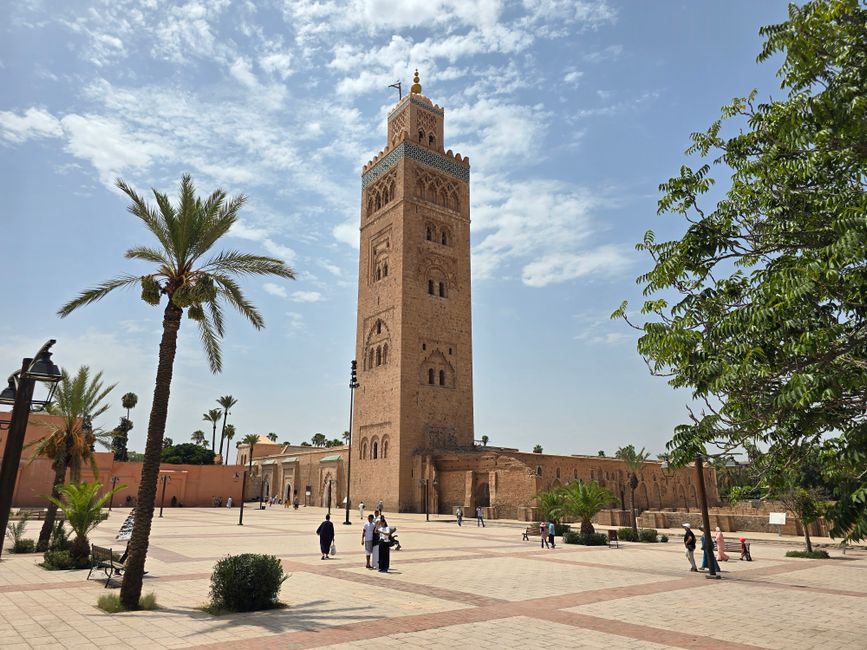
Photo: Zak H — Pexels
Part of our Morocco eSIM guide: all articles and key facts →
An eSIM for Marrakech works well: the city is one of the best-connected places in Morocco, and the regulator's own speed tests prove it. What decides your experience is which of the three Moroccan networks your eSIM uses. This guide gives the measured speeds for Marrakech and the rest of the country, what they mean for each network, and how to choose a plan for a Marrakech trip.
Key takeaways
- Marrakech is one of the three fastest cities in the ANRT's 2026 mobile tests: 168 Mbps on average across the three networks in May 2026, and 243 Mbps for the fastest operator.
- The network matters more than the price: Orange Maroc scored below the city average for download speed in Marrakech in May 2026, and on the Eid day of the March 2026 campaign, yet several travel eSIMs connect to Orange only.
- Coverage is solid in the city and on the roads to Essaouira and Agadir; for the Atlas villages and the desert, no official measurements exist, so download offline maps before leaving.
How fast is mobile internet in Marrakech?
Very fast by any travel standard. The ANRT, Morocco's telecom regulator, measured mobile data in the same ten large cities in two campaigns in 2026, with the same method. Both put Marrakech in the top three:
| ANRT campaign | Average download, 3 networks | Fastest operator | Connections that succeeded |
|---|---|---|---|
| 19–21 March 2026 | 186 Mbps | 243 Mbps | 99.49% |
| 26–28 May 2026 | 168 Mbps | 243 Mbps | 99.74% |
In May 2026 the average upload speed in Marrakech was 42 Mbps and the average latency 49 ms. A web page answered in 0.26 seconds and a YouTube video started in about 3 seconds. The tests ran on a Samsung Galaxy S23 in 2G, 3G, 4G and 5G mode, over three days around a public holiday, Eid al-Adha, so the results may not reflect an ordinary week.
The holidays themselves did not slow Marrakech down. On 20 March 2026, the day of Eid al-Fitr, the three networks averaged 193 Mbps there and the fastest operator reached 292 Mbps. On 27 May 2026, the day of Eid al-Adha, the average was 172 Mbps and the fastest 254 Mbps.
For comparison, the ANRT's last national campaign, run in late 2024 on 4G only before 5G launched, measured 106 Mbps on average in Marrakech. Much of the difference probably comes from 5G: Opensignal reports that Morocco's 5G averaged 212.8 Mbps in its first month, 6.9 times the speed of 4G. Its North Africa 5G study measured 228.4 Mbps over the 30 days to 28 February 2026.
Crowdsourced tests, run by users on their own phones wherever they are, give lower figures. Ookla's Speedtest Global Index put Morocco's median mobile download at 69.70 Mbps in its August 2026 edition, 64th in the world. That is a national median, not a Marrakech figure, and it is still far more than maps, messaging and video calls need.
Which network is best in Marrakech?
Maroc Telecom and inwi measured faster than Orange Maroc in Marrakech in 2026. The ANRT does not publish each operator's own figure. It publishes the three-network average, the best operator's figure, and a symbol for each operator compared with the average. That symbol is the useful part for a traveller:
- Orange Maroc was marked below average for download speed in Marrakech in May 2026, which in the ANRT's scale means between half and two thirds of the average, so under about 113 Mbps. In March 2026 it was below average on the holiday itself. For video start times, Orange was below average in all ten cities in May.
- Maroc Telecom and inwi were both in line with the average for download speed in Marrakech, and both above average for video. On the day of Eid al-Fitr in March, Maroc Telecom was rated at least 1.5 times the city average.
National studies point the same way. Opensignal's Morocco report for January to March 2026 names Maroc Telecom the best network overall, with the fastest average download (27.5 Mbps across all technologies) and the fastest 5G (280.2 Mbps). Orange's strength is 5G availability: its 5G users spent 51.2% of their time on 5G, against 44.6% for inwi and 38.7% for Maroc Telecom. inwi wins on reliability and video.
| Measure (source, period) | Maroc Telecom | Orange Maroc | inwi |
|---|---|---|---|
| Average download, all technologies (Opensignal, Q1 2026) | 27.5 Mbps | 23.7 Mbps | 22.8 Mbps |
| 5G download (Opensignal, Q1 2026) | 280.2 Mbps | 136.6 Mbps | 198.5 Mbps |
| Time on 5G for 5G users (Opensignal, Q1 2026) | 38.7% | 51.2% | 44.6% |
| Coverage Experience, 0 to 10 (Opensignal, Q1 2026) | 9.2 | 7.8 | 9.1 |
| Reliability Experience, 100 to 1000 (Opensignal, Q1 2026) | 791 | 744 | 815 |
| Video Experience, points (Opensignal, Q1 2026) | 49.6 | 40.1 | 52.3 |
| Average download (nPerf, year 2025) | 50.65 Mbps | 37.61 Mbps | 31.37 Mbps |
| Average latency (nPerf, year 2025) | 33.69 ms | 27.96 ms | 39.36 ms |
| Download in Marrakech vs city average (ANRT, May 2026) | In line | Below | In line |
Opensignal measures what users experience in everyday use, nPerf measures active speed tests, and the ANRT measures with a fixed protocol: the figures are not comparable with each other. Opensignal and nPerf both put Maroc Telecom first on download speed; the ANRT's May tests in Marrakech rated Maroc Telecom and inwi level with the city average, and Orange below it. Responsiveness is a different story. Orange has the lowest latency in the nPerf 2025 barometer, which is why it tops nPerf's overall score (74,096 points, against 71,158 for Maroc Telecom and 63,089 for inwi) while coming second for download speed.
Size tells a different story from speed. At the end of March 2026, Orange had the most mobile lines in Morocco (34.38%), ahead of inwi (34.04%) and Maroc Telecom (31.58%), according to the ANRT's mobile market report. For mobile internet subscriptions, inwi led with 43.37%, ahead of Maroc Telecom (29.17%) and Orange (27.46%). Our broader comparison of Maroc Telecom, Orange and inwi covers the rest of the country.
How does the ANRT test mobile speeds?
With a fixed protocol, the same phone in every city, and published rules for rating each operator. For the May 2026 campaign, the ANRT took 15,720 measurements across the three operators in ten cities. Each download test fetched a 300 MB file from a server at the ANRT's headquarters, with a 120-second time limit, and each upload test sent 150 MB. The video test played a 43-second YouTube clip, and the browsing test loaded google.com.
The measurements covered three days: the eve of Eid al-Adha from 10:00 to 18:00 and 20:00 to 23:00, the day itself from 7:00 to 13:00 and 14:00 to 23:00, and the next day from 8:00 to 13:00 and 14:00 to 20:00. The March campaign covered the same ten cities with 16,020 measurements. The May report names the cities but not the test sites, so there is no figure for a particular neighbourhood.
Each operator is then compared with the three-network average and given a symbol. For download speed, the scale reads as follows:
| Symbol | Operator's result compared with the average |
|---|---|
| + | Between 1.5 and 2 times the average |
| = | Between 0.67 and 1.5 times the average |
| - | Between 0.50 and 0.67 times the average |
| -- | Between 0.25 and 0.50 times the average |
For delays such as latency and video start time, the scale runs the other way, because lower is better. The reports use the operators' company codes: IAM for Maroc Telecom, MDT for Médi Telecom, the company behind Orange Maroc, and WANA for inwi. The May 2026 report and the March 2026 report are public PDFs in French.
Which network does your eSIM use?
The provider decides, not you: each travel eSIM is allowed onto one, two or all three Moroccan networks. esimdb, a comparison site, listed 10,754 Morocco plans from 214 providers on 25 September 2026. Of the 142 providers whose network it shows, 80 use Orange Maroc only, 34 use all three networks, and 20 use Maroc Telecom and Orange. Only three use inwi alone and three use Maroc Telecom alone.
On the providers' own pages on 25 September 2026, Airalo and Nomad named Orange as their only network in Morocco, and Holafly listed inwi, Maroc Telecom and Orange. eSIM Maroc says its plans use the local Moroccan networks and select the one available in each area automatically. Check this line before you pay: in Marrakech, an Orange-only plan is the slowest of the three options on the ANRT's figures, even though it remains fast enough for maps, messaging and video calls.
| Provider | Networks named for Morocco | Unlimited plan, 1 October 2026 |
|---|---|---|
| eSIM Maroc | Not named; local network chosen automatically | €24 for 7 days, 1 GB a day at full speed |
| Nomad | Orange | €23.69 for 7 days, 2 GB a day |
| Airalo | Orange | €32 for 7 days, 3 GB a day |
| Holafly | inwi, Maroc Telecom, Orange | €28.90 for 7 days, no daily figure published |
| Yesim | inwi, Maroc Telecom, Orange | €31.50 for 7 days, no daily figure published |
| Ubigi | Maroc Telecom, Orange | €25 for 7 days, 25 GB at full speed |
| Orange Travel | Orange, inwi, Maroc Telecom | €28.99 for 10 days (promotion), no fair-use figure |
Which Marrakech plan gives the best value?
It depends on how long you stay and how much you stream. On 1 October 2026, eSIM Maroc, the Morocco specialist linked from this site's menu, charged €6 for 1 day, €19 for 5 days, €24 for 7 days, €32 for 10 days and €45 for 15 days of unlimited data. Each plan gives 1 GB a day at full speed, then 512 kbps, and allows hotspot use.
For 5 to 15 days, that is cheaper than Holafly (€28.90 for 7 days), Airalo (€32 for 7 days; unlimited only up to 10 days), Yesim (€31.50 for 7 days) and Jetpac (about €27.62 for 7 days). Unlike Airalo, Nomad, Ubigi and Orange Travel, it also sells a 1-day unlimited plan, which suits a short stopover in Marrakech.
It is not the cheapest everywhere. Nomad is slightly cheaper (€23.69 for 7 days) with 2 GB a day, but it uses Orange only, the network that measured below average in Marrakech. Ubigi costs slightly more (€25 for 7 days) but gives 25 GB at full speed on Maroc Telecom and Orange. Orange Travel's promotion, valid until 15 November 2026, is cheaper at 5, 10 and 15 days (€15.99, €28.99 and €32.99) on all three networks, though it publishes no fair-use figure.
The main limit of eSIM Maroc is its daily allowance. 1 GB a day at full speed is the lowest cap among the well-known providers, so it suits maps, messaging, social media and calls rather than hours of streaming or a laptop on hotspot. Heavy users get more fast data from Nomad (2 GB a day) or Airalo (3 GB a day).
Is there 5G in Marrakech?
Yes: Morocco switched on 5G on 7 November 2025, and Marrakech was part of the first wave. Orange's official list of 135 places covered by its 5G, dated 5 November 2025, includes Marrakech and the nearby towns of Tamansourt and Aït Ourir. Maroc Telecom and inwi have not published a city list; Maroc Telecom states that phones switch automatically to 4G+ outside its 5G zones.
Each operator holds 2 × 10 MHz in the 700 MHz band and 50 to 100 MHz in the 3.5 GHz band for 5G, according to Opensignal. A town on the list has at least one covered zone, not necessarily every street. Orange's list does not say which neighbourhoods are covered, and no official source details the medina, Guéliz, Hivernage, the Palmeraie or the airport.
Two limits apply. First, 5G is still the exception: at the end of March 2026, only 8.4% of Morocco's 38.105 million mobile internet subscriptions were 5G, against 86.8% on 4G, according to ANRT figures. Three months earlier, 5G stood at 6.8%. Opensignal's 5G Coverage Experience scores were between 0.28 and 0.41 out of 10 for the three operators in early 2026, a sign that 5G still reaches only a small share of the places people go.
Second, no official source confirms that visitors on a travel eSIM get 5G while roaming, so treat any 5G on a travel plan as a bonus, not as something you pay for. Most providers' plan data say 4G or LTE even when their marketing mentions 5G. Your phone also needs 5G support: our iPhone 17 and Galaxy S26 pages list eSIM details per model.
Is mobile data faster than riad Wi-Fi in Marrakech?
Often, yes. Ookla measured a median fixed broadband speed of 28.96 Mbps in Marrakech at the end of 2024, below Rabat (36.55 Mbps) and Casablanca (35.57 Mbps). Riad and hotel Wi-Fi runs on those fixed lines and is shared between guests.
The fixed operator behind the riad matters too. In Ookla's study of fixed internet and hotel Wi-Fi, Maroc Telecom's fixed medians ranged from over 43 Mbps in Agadir to about 60 Mbps in Casablanca, while Orange's fixed median in Marrakech was 14.1 Mbps.
Even luxury hotels stay well below the mobile networks. Between August 2023 and February 2025, La Mamounia measured a median of 54.64 Mbps on its Wi-Fi, a third of the city's 2026 mobile average. The Royal Mansour Marrakech measured between 25 and 50 Mbps for download, and the Four Seasons Marrakech about 19 Mbps.
For a video call or a large upload in Marrakech, a mobile data plan and a hotspot from your phone is frequently the faster connection. The catch is indoors: Opensignal notes that the most common dead zones occur inside buildings, so a room deep inside a riad may still need the Wi-Fi. Check that your plan allows hotspot use: our comparison of Morocco eSIMs lists it provider by provider.
How does Marrakech compare with other Moroccan cities?
Marrakech sits near the top in both the 2026 and the 2024 tests. The May 2026 campaign covered ten cities in 2G, 3G, 4G and 5G mode:
| City (ANRT, 26–28 May 2026) | Average download, 3 networks | Fastest operator |
|---|---|---|
| Rabat | 171 Mbps | 200 Mbps |
| Marrakech | 168 Mbps | 243 Mbps |
| Tanger | 164 Mbps | 193 Mbps |
| Agadir | 161 Mbps | 235 Mbps |
| Meknès | 159 Mbps | 205 Mbps |
| Casablanca | 153 Mbps | 166 Mbps |
| Laayoune | 143 Mbps | 179 Mbps |
| Fès | 138 Mbps | 193 Mbps |
| Tétouan | 132 Mbps | 159 Mbps |
| Errachidia | 91 Mbps | 114 Mbps |
| All ten cities | 148 Mbps | 177 Mbps |
Marrakech shows the widest gap in the table between the three-network average and the fastest operator: 75 Mbps. Orange was marked below average for download in six of the ten cities, Marrakech, Agadir, Meknès, Laayoune, Fès and Tétouan. The lesson is the same everywhere: the network your eSIM joins decides your speed more than the city does.
The ANRT's 2024 national campaign is the only one that covers the smaller tourist towns, so it is the best guide for a tour of the country. It measured 71 cities between 6 November and 18 December 2024, on 4G only, before 5G:
| City (ANRT, late 2024, 4G) | Average download, 3 networks | Fastest operator |
|---|---|---|
| Fès | 119 Mbps | 169 Mbps |
| Agadir | 114 Mbps | 156 Mbps |
| Marrakech | 106 Mbps | 162 Mbps |
| Ouarzazate | 102 Mbps | 124 Mbps |
| Casablanca | 97 Mbps | 119 Mbps |
| Rabat | 92 Mbps | 111 Mbps |
| Tinghir | 91 Mbps | 117 Mbps |
| Essaouira | 89 Mbps | 107 Mbps |
| Tanger | 87 Mbps | 104 Mbps |
| Errachidia | 78 Mbps | 139 Mbps |
| Chefchaouen | 73 Mbps | 106 Mbps |
| Zagora | 73 Mbps | 102 Mbps |
| Arfoud | 69 Mbps | 69 Mbps |
Every town in the table was measured at over 65 Mbps, well beyond what a traveller needs for maps, messaging and video calls. In 2024 Marrakech's average upload, 62 Mbps, was also higher than Ouarzazate's (59 Mbps), Agadir's (48 Mbps) or Casablanca's (44 Mbps). Merzouga, on the edge of the Erg Chebbi dunes, was not measured; Arfoud and Errachidia are the nearest measured towns.
How good is the signal on day trips from Marrakech?
Good on the main roads, at 62 to 84 Mbps on average in the ANRT's 2024 tests. The 2024 campaign measured 6 motorways, 27 national roads and 6 rail lines as well as the cities, with 110,942 measurements in all. On the national roads, 97.79% of connections succeeded, against 99.58% in the cities.
| Route (ANRT, late 2024, 4G) | Average download, 3 networks |
|---|---|
| Zagora–Ouarzazate road | 84 Mbps |
| Marrakech–Safi road | 80 Mbps |
| Beni Mellal–Marrakech road | 73 Mbps |
| Ouarzazate–Tinghir road | 69 Mbps |
| Rabat–Marrakech–Agadir motorway | 68 Mbps |
| Errachidia–Ouarzazate road | 68 Mbps |
| Marrakech–Essaouira road | 65 Mbps |
| Marrakech–Agadir road | 62 Mbps |
| Casablanca–Marrakech train | 53 Mbps |
Trains are the weak spot. Across the six rail lines, the average was 46 Mbps with a latency of 156 ms, against 50 ms in the cities. The high-speed Al Boraq line between Kénitra and Tanger was the weakest route measured, at 25 Mbps. The full figures are in the ANRT's 2024 national report, in French.
The operators' licences require an average of at least 2 Mbps, so every route in the table beat the legal minimum many times over. The routes missing from the list matter as much as those on it, which is the subject of the next section.
What about the Atlas, Ourika and the desert?
Nobody has published a measurement for them. The ANRT's 27 measured national roads do not include the N9 over the Tizi n'Tichka pass, and no official or independent test covers Imlil, the Ourika valley, the Agafay desert or Merzouga. Orange's 5G list does not include Merzouga, Tinghir, Imlil or Ourika, nor Rissani, Arfoud, Skoura or Boumalne. Taroudant, on the other hand, is on it.
Nationally, Morocco's digital ministry reports 4G coverage for 98.63% of the population, but that counts where people live, not empty mountain roads or dunes. Under the first national high-speed plan, 10,620 localities had 4G at the end of March 2024, 98.88% of the 10,740 recorded. A second plan, launched in 2024 for two years, targets the places still uncovered, partly with satellite links and outdoor Wi-Fi.
An earlier ANRT programme, PACTE, now closed, brought mobile service to 9,263 rural localities with about 2 million inhabitants. That explains why many Atlas villages have a signal, but it does not measure how fast it is.
The practical rule follows: download offline maps and your booking details before leaving Marrakech, and expect gaps between villages. A plan that can use more than one Moroccan network gives you a better chance of a signal where one operator's mast is out of reach. For a route you know in advance, nPerf publishes crowdsourced coverage maps by operator.
Which eSIM should you choose for Marrakech?
- Check the network first. In Marrakech, Maroc Telecom and inwi measured faster than Orange in 2026. A plan that names all three, or picks the best local network automatically, avoids being tied to the slowest one.
- Match the plan to your stay. A long weekend and a two-week tour call for different plans. Our price-per-day comparison shows which plan is cheapest for each length.
- Look at the daily cap if you choose "unlimited". Our guide to unlimited Morocco eSIMs lists the real limits.
- Install before you fly. Our installation guide covers the settings, and the airport guide covers Marrakech Menara on arrival.
Before you buy anything, make sure your phone has the eSIM chip: see the list of compatible phones, or use the free eSIM Check app on Android, which reads your device's real hardware capabilities in seconds.
Frequently Asked Questions
Does an eSIM work in Marrakech?expand_more
Which is the best mobile network in Marrakech?expand_more
Is there 5G in Marrakech?expand_more
Does mobile data work in the Marrakech medina?expand_more
Is there free Wi-Fi at Marrakech airport?expand_more
Check your own phone in seconds
The free eSIM Check app reads your device's real hardware capabilities — no guesswork.
Get it on Google Play